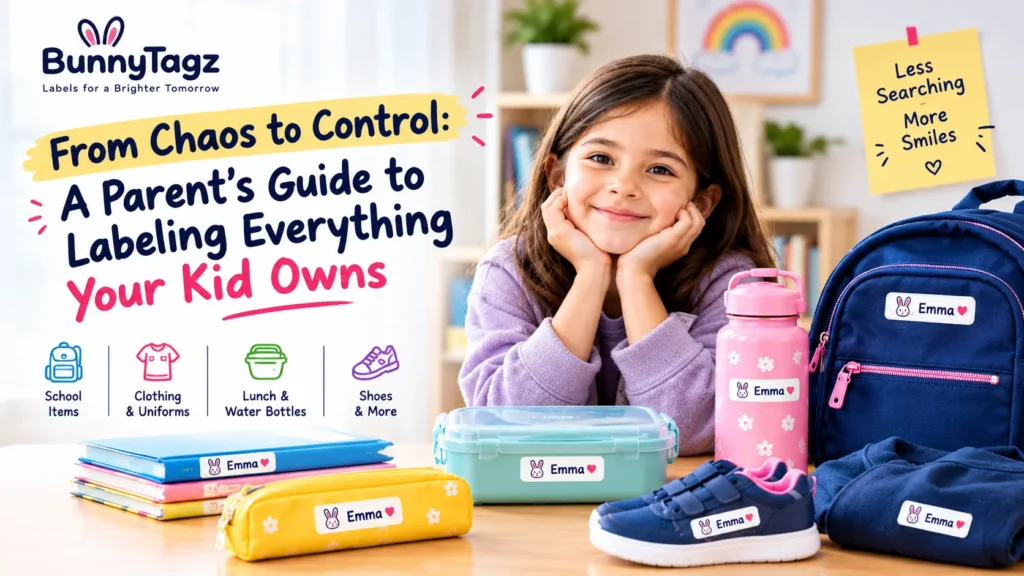
If your mornings involve searching for a missing shoe, hunting down a sweater that “disappeared” at daycare, or replacing yet another water bottle, you’re not disorganized — you’re just missing one system. Labeling every item your child owns is the single change that turns daily chaos into something predictable and manageable. This guide walks through exactly what to label, which label type to use for each category, and how to set the whole system up in one sitting.
We built BunnyTagz around this exact idea: that a few minutes of labeling up front saves parents hours of searching, replacing, and stressing later. Here’s how to do it properly.
Why “Just Write Their Name on It” Doesn’t Work Anymore
Every parent has tried the marker-on-the-tag approach. It works for about two weeks. Then the ink fades, the tag gets cut off, or the item goes through the wash and the name disappears entirely. The problem isn’t effort — it’s that a name needs to survive daily use, water, washing, and handling to actually do its job. That requires a label built for the specific item it’s protecting, not a one-size-fits-all marker line.
Step 1: Take Inventory of What Actually Needs Labeling
Before buying anything, walk through your child’s daily routine and list every item that leaves the house:
- Backpack and lunch bag
- Water bottle and food containers
- Uniform pieces, jackets, and sweaters
- Shoes and boots
- Stationery — pencil cases, notebooks, pencils
- Sports or activity bags
- Stuffed animals or comfort items that go to daycare
Most parents are surprised by how long this list is once they actually write it down. That’s normal — and it’s exactly why a scattered, item-by-item approach to labeling tends to fall apart halfway through the year.
Step 2: Match Each Item to the Right Label Type
Different materials need different labels to survive. Using the wrong type is the most common reason labels fail within weeks.
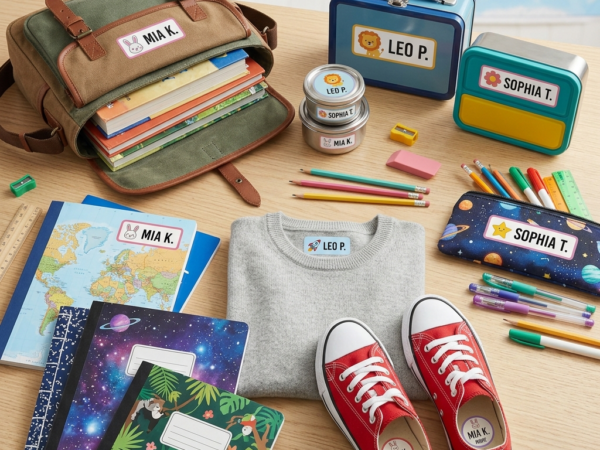
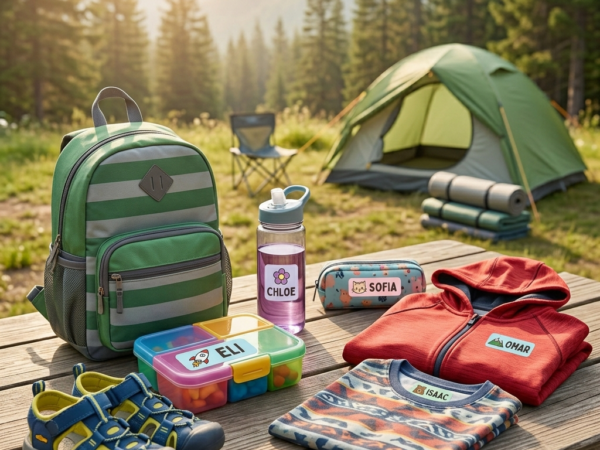
Waterproof stickers — for water bottles, lunch boxes, snack containers, and anything washed by hand or dishwasher. Our waterproof name labels are designed with a strong adhesive and scratch-resistant finish so they hold up to daily washing without peeling or fading.
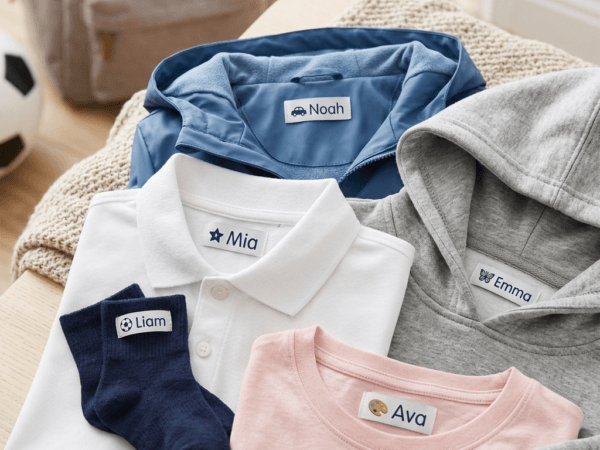
Iron-on clothing labels — for uniforms, jackets, sweaters, and anything that goes through the washing machine and dryer regularly. Our clothing labels are designed to bond with fabric fibers so they survive full wash-and-dry cycles all year, not just a few washes.
Shoe labels — shoes take a different kind of abuse than clothing or containers: scuffing, mud, constant friction, and being pulled on and off multiple times a day. Our dedicated shoe labels are built specifically to handle that wear.
Step 3: Label in One Sitting, Not Item by Item
The biggest reason labeling systems fail is that they get done piecemeal — one bottle here, one jacket there — and half the wardrobe stays unlabeled. Set aside 20–30 minutes, gather every item from your list, and go through them category by category: containers first, then clothing, then shoes. Batching the process means nothing gets missed and nothing has to be “done later.”
For families labeling a full school or daycare kit at once, our Smart Choice Combos bundle waterproof, clothing, and shoe labels together, so you’re not placing three separate orders to cover three different item types. You can see exactly how a design will look on each item type before ordering — check how it works for the full process.
Step 4: Make It a Standing Habit, Not a One-Time Project
Labeling shouldn’t be a once-a-year scramble before school starts. Build it into how you shop:
- Label new items before they’re used for the first time, not after they’ve already been lost once
- Keep a few spare labels on hand for birthday gifts, new shoes, or replacement water bottles
- Re-check labels each season, since kids grow into new sizes and new items throughout the year
Treating labeling as an ongoing habit — rather than a single event — is what keeps the system working all year instead of only for the first month of school.
What Changes Once Everything Is Labeled
Parents who fully label their child’s belongings consistently report the same shift: fewer replacement purchases, less time spent searching bags and lost-and-found bins, and less friction with kids who no longer get blamed for “losing” things that were never set up to be found in the first place. It’s a small upfront investment that quietly removes an entire category of daily stress.
Ready to Set Up Your System?
Stop labeling one item at a time and set your child’s entire kit up properly. Shop BunnyTagz name labels and cover water bottles, lunch containers, clothing, and shoes in a single order. Every design is customizable with your child’s name, color, and icon, and every order ships free across Canada.
Frequently Asked Questions
What’s the most efficient way to label all of my child’s belongings?
Take inventory of everything your child uses daily, then batch your labeling by category — containers, clothing, and shoes — in one sitting using the label type designed for each surface.
Do I need different labels for clothes versus water bottles?
Yes. Clothing needs an iron-on label designed to bond with fabric through the wash, while water bottles and containers need a waterproof sticker built for dishwashers and daily handling.
How often should I check or replace name labels?
Check labels at the start of each season and whenever your child gets new items. Quality waterproof and iron-on labels are designed to last the life of the item, so replacement is rarely needed if the right label type was used from the start.
Is it worth labeling stuffed animals and comfort items?
Yes. Comfort items are often the most emotionally significant things a child owns, and they’re just as easy to leave behind at daycare or on a trip. Labeling them the same way as school items protects against losing something irreplaceable.
Can I label items I already own, or only new purchases?
You can label anything, new or already in use. There’s no need to wait for new items — go through your current backpack, lunch bag, and wardrobe and label what’s already there.
How long does it take to label an entire school kit?
With labels matched to each item type and a combo pack that covers waterproof, clothing, and shoe needs at once, most parents can label a full kit — bottles, containers, uniform pieces, and shoes — in about 20–30 minutes.
Leave a Reply