There’s a specific kind of Sunday evening energy that arrives about a week before school starts. The uniform is bought. The bag is somewhere. The stationery list has been worked through, mostly, except for one type of ruler that apparently exists only at one shop, and that shop has sold out. Everything is functional. Nothing is particularly exciting.
And then your child picks up a plain navy pencil case, looks at it for a moment, and puts it back down with the energy of someone who has been handed a form to fill in.
This is the gap that personalization fills. Not just aesthetically — though that matters — but practically. A child who has a pencil case that feels like theirs, that has their name on it in a color they chose, that has a small sticker they picked out themselves, treats that pencil case differently from one that came out of a multipack. They notice when it’s gone. They look for it. They bring it home.
That’s the real argument for personalizing school supplies. Not that it looks nice, though it does. That it works.
Start with the Name, But Make It Theirs
Every school supply needs a name on it — that part isn’t optional if you’d like to see any of it again by Christmas. But the way you put that name on matters more than most parents initially think.
A marker pen works until it doesn’t. Three washes in, the name on the collar has faded to a point where it requires squinting and optimism to read. The initials on the lunchbox lid have smeared into a shape that could belong to anyone. This is not a system. This is a temporary measure that creates the illusion of organization while the actual organization quietly falls apart.
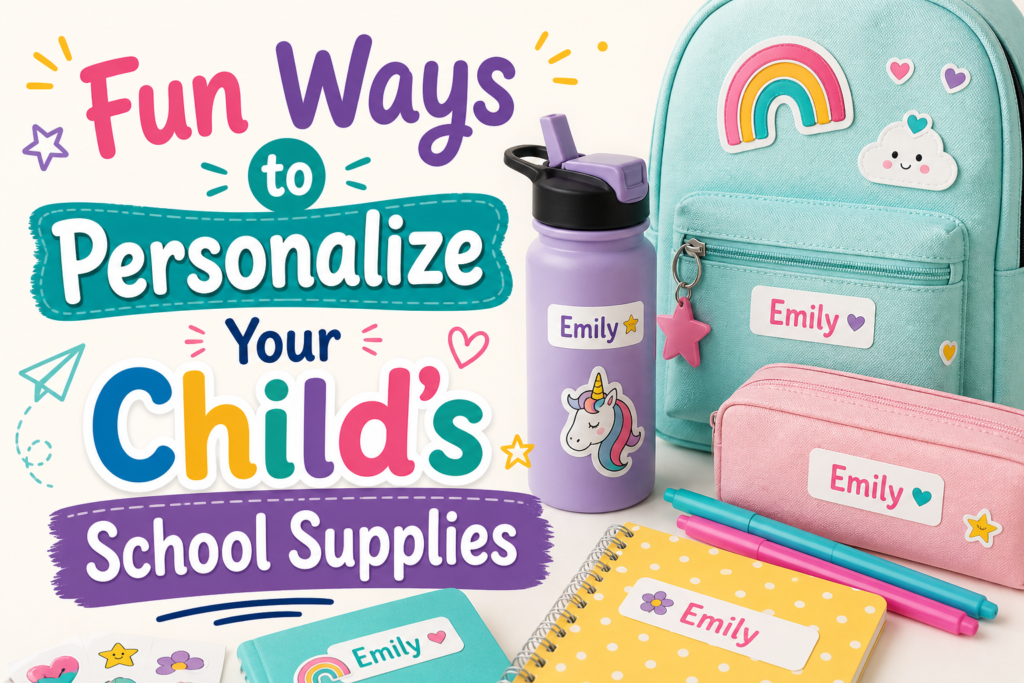
Custom name stickers are the better version of this — and the difference between a sticker that lasts a term and one that lasts a year is almost entirely about where you buy them. BunnyTagz stickers survive the dishwasher, the washing machine, and the specific punishment a primary school child delivers to everything they own, which is considerable and should not be underestimated. But the other thing they do — the thing that matters for the personalization angle — is that they actually look good. Proper colours. Clean designs. Something the child looks at and recognizes as theirs, rather than something an adult stuck on while the child was in another room.
Let the child choose. The color, the design, whatever options there are. It takes five extra minutes and changes the child’s relationship to the object entirely.
The Pencil Case as a Starting Point
If there’s one item worth personalizing properly, it’s the pencil case. It’s the thing that sits on the desk every day. The thing that gets picked up and put down dozens of times. The thing that, in a classroom of thirty children, needs to be immediately identifiable as belonging to one specific person.
A name sticker on the outside is the baseline. But beyond that, the pencil case itself can be an expression of something. A color the child is currently obsessed with. A pattern that feels like them. A small iron-on patch, if it’s fabric. A keyring clipped to the zip. None of these costs much. All of them transform a functional object into something a child actually wants to carry around.
The practical benefit is real: a distinctive pencil case is easier to spot across a classroom, easier to identify in a lost property box, and less likely to be picked up by someone else by accident. The personal benefit is realer: a child who likes their pencil case takes better care of it. This is not a theory. Ask any teacher which children’s stationery stays intact through the year, and they will describe children whose things look deliberately chosen rather than generically purchased.
Water Bottles That Are Actually Theirs
Water bottles pose a specific problem in primary schools: they are all more or less the same. Same shape, similar colors, lids that all function in roughly the same way. They get put down in groups during PE, lined up on tables during lunch, left in cloakrooms, and picked up by whoever’s nearest when it’s time to go.
A name on the bottle helps. A name on the bottle, plus a design the child actually likes, helps more because it makes the bottle visually distinctive in a way that goes beyond just text. A child who has a water bottle with their name on it in their favorite color, with a small sticker they chose themselves, knows their bottle at a glance. They’re not doing a label-check. They know.
This sounds trivial. It is not trivial at the end of a school day when fifteen children are collecting bags from the same cloakroom peg area, and everyone is tired, and the teacher is trying to get them all out the door. The distinctive bottle goes home with the right child. The anonymous one goes in the lost property box.
Stickers designed for bottles need to be waterproof — properly waterproof, not just water-resistant — because a bottle sticker that peels after two weeks has served no useful purpose. This is one of those places where the sticker’s quality actually determines whether the system works at all.
Lunchboxes That Come Home Every Day
The lunchbox is another high-attrition item that benefits more from personalisation than parents expect.
Beyond the name — which is essential, non-negotiable, the starting point — a lunchbox that looks like the child’s own becomes part of their daily rhythm. They know it. They claim it. They notice if it’s missing in a way that children don’t notice with objects that look interchangeable.
A few small additions make a lunchbox genuinely personal. A sticker on the lid that the child picked. Their name is in the color they wanted. If the lunchbox itself is a plain solid color, a couple of small personalization stickers on the sides turn it from an object that could belong to anyone into one that clearly belongs to a specific person.
The practical upside of this is not subtle. In a primary school dining hall with forty lunchboxes all put down in roughly the same area at the same time, the one that looks different gets found faster, returned faster, and comes home the same day rather than sitting in the office for a week while its owner wonders where their lunch container went.
Uniform That Survives the Year
Labeling uniform is one of those tasks that sound boring enough that parents leave it too late, do it in a rush, and end up with half the items labeled and the other half operating on the honor system. The honor system does not work in a primary school cloakroom.
The personalization angle here is less about decoration and more about durability and visibility. A name label inside a jumper collar that looks clear and readable at the end of March is doing more work than one that faded in November. This is where sticker quality actually matters — not as a luxury consideration but a practical one.
For children who are old enough to have opinions about their things — which is most children by Year 2 — giving them some input into how their uniform is labeled makes a quiet difference: choosing the label color and deciding whether it goes inside the collar or on the label seam. Small choices, but they create a sense of ownership that generic supermarket-aisle iron-on labels don’t.
Books, Folders, and the Paper Trail
Upper primary children use more paper than anyone in the household can fully account for. Folders, exercise books, reading records, project folders, homework diaries, music books if they’re having lessons — all of it cycling between home and school continuously, all of it looking similar to everyone else’s.
A name sticker on the front cover of every folder. A name sticker is inside every book. Not because children are careless — though some of them are, and that’s fine, they’re children — but because in a busy classroom, books get moved, borrowed, picked up by accident, left on tables. The ones with clear names on them complete their journey home. The ones without names become communal objects by default.
For older children, letting them personalize their folders goes beyond practicality. A Year 5 child who has decorated their maths folder, even minimally — a name sticker in their preferred style, a small design they chose — treats that folder differently. It is theirs in a felt sense, not just a technical one. It comes home. It stays intact. It doesn’t get left on a table because it didn’t feel like it was meant to be there to begin with.
The Bit That’s Easy to Skip
The temptation, especially in the final days before term starts, is to do the minimum. Get the name on the main items. Leave the smaller stuff. Decide the stationery doesn’t need labeling because it’s cheap enough to replace.
This logic works right up until the moment it doesn’t — which is usually about three weeks in, when the pencil case is somewhere in the school building doing its own thing, the second water bottle is already a replacement for the first. A different family has apparently adopted the reading folder.
Personalize everything, properly, once. Let the child be part of it where possible. Choose stickers that will actually last. Then move on and stop thinking about it, because that’s what a good system allows you to do — stop thinking about it.
The school year is long. The things in it should at least look like they belong to someone.
BunnyTagz offers personalized name stickers for every school supply — designed to last, made to be chosen, and built for the real conditions of school life because the pencil case should make it home.
Leave a Reply