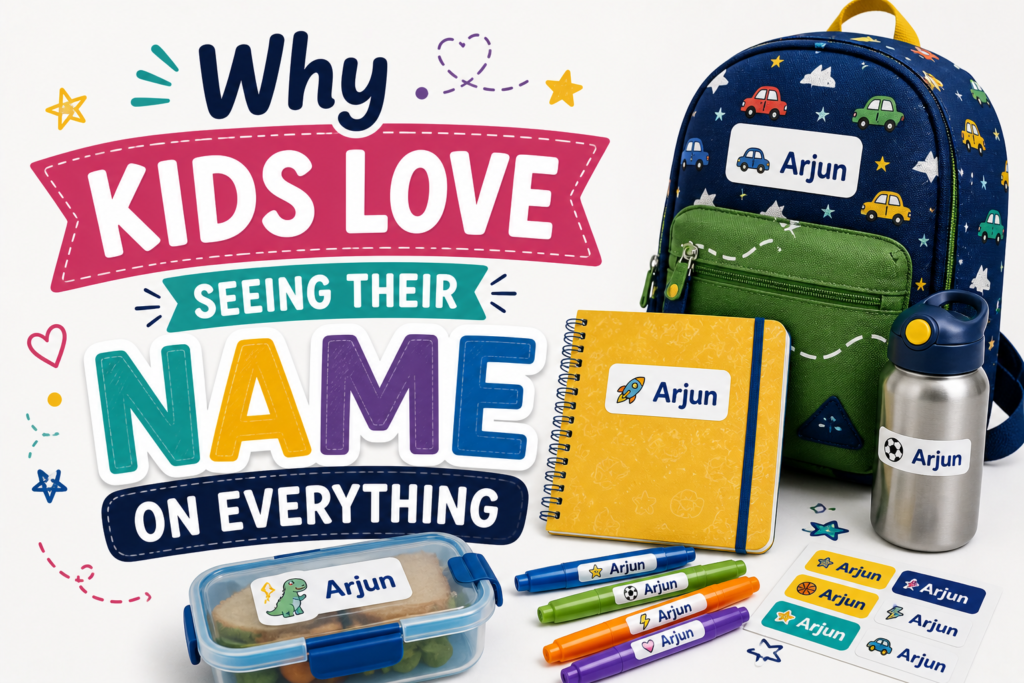
Watch a child the first time they see their name on something. Not written by them — written for them. On a sticker, on a bag tag, on a water bottle, they’re about to take them to school for the first time. There’s a moment, usually about two seconds long, where something shifts. They look at it. They look up. They look at it again. And then they want to show someone.
It’s one of those small childhood moments that’s easy to walk past without thinking too hard about it. But there’s something real happening in those two seconds, something that goes beyond just liking the way it looks. Understanding what that something is explains a lot about why personalization — done properly, with things like quality custom stickers rather than a marker pen scrawl — works so much better than the generic alternative.
A Name Is the First Thing That Belongs to Them
Before children own much of anything, they own their name. It arrives before they can speak it. It’s the first word most of them recognize in print. It’s what gets called at the dinner table, at bedtime, across a playground. It is, in a very direct sense, the earliest and most reliable signal that something is addressing them specifically and nobody else.
So when a child sees their name on an object — on a lunchbox, on a pencil case, on a tag attached to their school bag — that object gets pulled into the same category as the name itself. It becomes theirs in a way that goes deeper than just possession. It’s not just a lunchbox. It’s their lunchbox, with proof attached.
This matters more at certain ages than others. For children in early primary, especially where so much of the day involves navigating things that belong to groups, to the class, to the school — having objects that are visibly, provably individual is genuinely meaningful. The jumper with their name in it is the one that comes home. The water bottle with their name on it is the one they look for at the end of PE. The pencil case with their name sticker in the color they chose is the one they notice when it’s gone.
BunnyTagz understood this well enough to build their whole product around it — not just labels, but labels the child has some say in. The color, the design, the way it looks sitting on the bottom of a lunchbox or inside a collar. That small act of choosing turns a practical necessity into something the child feels ownership over, which is a completely different thing.
It Tells Them They Were Thought About
Here is what a child actually receives when they see their name on something, underneath the surface excitement: evidence that an adult thought about them specifically. Not in a general way. In a particular way.
Children are very good at sensing the difference between something done for them and something done in their direction. A generic lunchbox from a supermarket shelf is fine. A lunchbox with their name on it in their favorite color, chosen with them in mind, is something else entirely. One was purchased. The other was considered.
This sounds like it’s heading toward something sentimental, and it is, slightly — but it’s also just accurate. The research on children and belonging is fairly consistent: children who feel individually seen in their environments engage more, take better care of their belongings, and feel more secure in new or unfamiliar spaces. A personalized name sticker on a school bag won’t resolve a child’s anxiety about starting Reception. But it is a small, concrete, visible piece of evidence that they belong there. That this bag was made for them. That somebody thought about this specific child going to this specific school and put their name on their things.
Small things are not always small.
The Ownership Effect Is Real
There’s a well-documented tendency among people of all ages to value things more once they feel ownership of them. Psychologists call it the endowment effect. Children demonstrate it constantly, with a purity that adults have mostly learned to hide.
A child who sees their name on their pencil case owns that pencil case in a way they didn’t quite before the name appeared. They’re more likely to notice when it’s missing. More likely to go back for it. More likely to feel something when it gets lost — not just inconvenience, but genuine loss, the kind that motivates finding it.
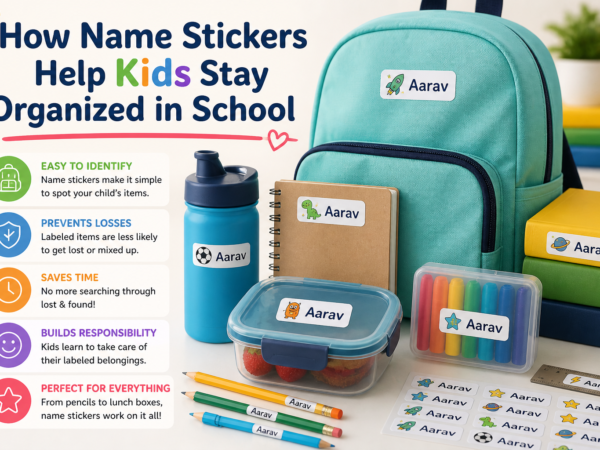
This has a practical outcome: parents learn to appreciate it quickly, usually after a term of unlabelled things disappearing. Labeled belongings come home more consistently, not just because teachers can return them, but because the child is more invested in their return. The named water bottle gets picked up at the end of PE. The named jumper gets noticed when it’s left on a peg. The named pencil case gets looked for when it’s not in the bag.
It’s not a perfect system. Children are still children, and some things disappear regardless of how many names are on them. But the rate of return, anecdotally and practically, is meaningfully better when the child feels the object is genuinely theirs — and nothing signals that faster or more clearly than seeing their own name on it.
Choosing Makes It Theirs in a Different Way
There’s a version of labeling that parents do to their children’s things — quietly, in the evening, while the child is asleep — and another they do with them. Both result in names on objects. Only one of them results in a child who’s excited about the objects.
When a child picks the color of their name sticker, something shifts in how they relate to the thing it goes on. They decided against it. They were consulted. They had a preference, and that preference was acted on. That’s a different kind of ownership than having a label stuck on while you weren’t looking.
This is genuinely why the design of something like a BunnyTagz sticker matters beyond aesthetics. It’s not just that it looks better than a supermarket iron-on label — it’s that the range of choices creates a moment of participation. The child who chose the blue sticker with their name on it for their water bottle has a relationship with that water bottle that starts before they ever take it to school. They helped make it theirs. They will remember to bring it home in a way they might not have otherwise.
For younger children especially, this kind of agency — small, low-stakes, but real — is genuinely valuable. They are told what to wear, when to sleep, what to eat, and where to go. The color of their name sticker is theirs to decide. That’s nothing.
It Helps Them Feel Settled in New Places
Starting school — or starting at a new school, or moving into a new classroom, or beginning a new year with a new teacher — involves a specific kind of disorientation that children don’t always have language for. Everything is unfamiliar. The rules are new. The faces are new. Even the smell is different.
In that context, objects from home take on an outsized importance. The lunchbox from the kitchen. The water bottle that lives on the shelf by the door. The pencil case was packed together on a Sunday evening. These objects carry a kind of continuity — they’re from the known world, arriving in the unknown one.
When those objects bear the child’s name, the effect is amplified. The name is the most familiar thing in the world to a five-year-old. Seeing it on their things, in their classroom, in their new environment, is a small, repeated reassurance. You are here. These are yours. You belong in this place.
It sounds like more than a sticker should be able to do. But objects carry meaning in proportion to the attention given to them, and a named, chosen, personalized item carries considerably more than an anonymous one.
The Practical and the Personal, Together
Most of the conversation around name stickers sits firmly in the practical column. Stop things from getting lost. Make it easier for teachers to return belongings. Survive the washing machine. All of that is real and worth saying.
But the reason children respond to seeing their name on things — the reason that two-second look happens, the reason they want to show someone — is not practical. It’s personal. It’s the oldest, simplest form of recognition: someone put your name on this, which means this is yours, which means you matter enough to have things that are specifically, visibly, durably yours.
That’s what’s happening in those two seconds. It’s worth designing for.
BunnyTagz makes personalized name stickers in designs children actually want on their things — because the best label is the one the child is proud to show off, not just the one that survives the dishwasher. Both, ideally.
Leave a Reply