
There’s a particular kind of morning that every parent has lived through at least once. It’s twenty past eight, you’re already behind, and your child is standing at the front door with one shoe on, completely frozen, asking where their water bottle is. The one you definitely packed. The one with their name written on it in marker back in September — now a ghost of a smudge that even you can barely make out under good lighting. It’s at school. Almost certainly in the lost-and-found somewhere. Because whoever found it couldn’t tell whose it was, so they just put it in the pile with everything else.
This is what name stickers exist for. Not as a life hack. Not as a Pinterest project. Just as a practical, unsexy solution to a problem that repeats itself every single week of the school year.
They won’t win any awards. No parenting influencer is building a following. But the mum who’s put three kids through primary school will tell you — unprompted, with feeling — that labeling everything properly is one of the best habits she ever developed. Usually, while standing next to the lost property box.
That Corner Every School Has
You already know the one. Near the office, or propped outside the hall, or balanced on a bench that somehow became the unofficial dumping ground. A heap of jumpers that have been there since October. A lunchbox with initials scratched into the lid in biro — close, but not quite readable enough to track down an owner. PE bags zipped up and waiting, patient as anything—one shoe. Just the one, always, and nobody ever explains it.
Walk past on a Friday, and there’s noticeably more in the pile than there was Monday morning. It just builds up, silently, while at home, a parent is entirely convinced their child’s cardigan is in their school bag.
Kids don’t misplace things the way adults do. When an adult loses something, there’s an immediate mental alarm: Where did I last have it? Retrace the steps, check the pockets. Kids don’t work like that. A seven-year-old puts a jumper down at breaktime, and that jumper ceases to exist in their world. Completely. They’ll trade water bottles with whoever’s sitting next to them at lunch and walk home with someone else’s without a flicker of concern. Leave a pencil case on the library table on Tuesday afternoon and genuinely not register its absence until Thursday evening, ten minutes before homework is due.
Stickers don’t stop any of that from occurring. What they do is change the outcome — a teacher picking up a labeled lunchbox knows whose it is in three seconds. It goes back. The small crisis never escalates.
What Happens When a Child Sees Their Name on Things
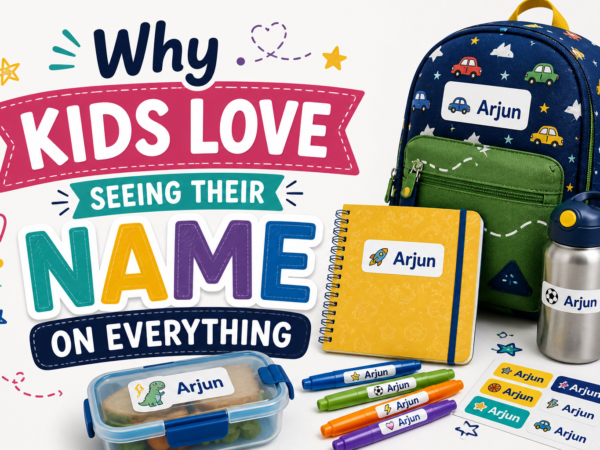
This part gets overlooked because it sounds a bit abstract, but it’s worth saying anyway. When a child’s name is on their things — their bottle, their bag, their pencil case — those objects feel like theirs in a way that actually registers. Not just technically theirs, but theirs. Something to notice when it’s gone. Something worth keeping track of.
It’s a subtle shift that doesn’t happen overnight. But over the course of a school year, a child who’s used to seeing their name on everything gradually develops a low-level ownership instinct that a child with unlabelled belongings doesn’t have as strongly. They spot when something’s missing. They go back for it. They feel the loss in a way that prompts them to act.
What BunnyTagz understood — and built their whole thing around — is that the sticker itself has to be worth something to the child. If it’s a dull printed label slapped on without thought, it blends into the background. But when a child picks the color, chooses a design, sees something that looks genuinely like theirs on the bottom of their lunchbox — that changes the relationship to the object entirely. It stops being a parental admin task and starts being something the child is actually invested in—a small distinction. Real difference.
The Practical Side, Which Sneaks Up on You
Most parents don’t fully understand what proper labeling does for them until they’ve spent a term without it. The realization usually arrives around week six, somewhere in the school office, while you’re trying to describe a navy cardigan.
Size 5-6. No logo. No hood. Just… navy. Like all of them.
Because that’s the uniform situation — every child in Year 2 is wearing a version of the same thing, often from the same shop, sometimes ordered the same week. After PE, when everything comes off in a rush and lands in a heap, there’s genuinely no way to sort it without names. Teachers are patient people, but they are not forensic analysts. A name inside the collar means the right cardigan goes home with the right child. Easy. Solved. The alternative is to hand-wash a jumper that belongs to someone in 2 B on Tuesday evening.
Lunchboxes have their own version of this. Kids put bags down together at lunch, grab the nearest one when the bell goes, and sometimes don’t realize until they’re unpacking at the kitchen table that everything inside is wrong. A name on the box means it comes back. No name means it sits in a pile until someone eventually throws it away.
Stationery is where the losses are quietest and most consistent. Nobody deliberately takes anyone else’s pencil. It just migrates — desk to desk, tray to bag, classroom to classroom — through a process of small, thoughtless movements across an entire week. The child who started Monday with a full pencil case is sitting there Friday afternoon with a single, blunt HB and a dried-out felt tip, sincerely mystified. A name on the pencil case doesn’t keep stationery in place. But it gives a teacher something to work with when they find three rubber bands under a radiator at home time. Not a guarantee. Just a better shot at getting it back.
The Hour in Late August That Earns Its Keep
Every parent who’s got the system down will say the same thing: do it all at once, before term starts, not reactively through October.
Last week of August. Kitchen table. Full pile of uniform, bags, stationery, and kit. One sheet of stickers. Work through the whole lot.
Nobody pretends this is a good time. The summer is winding down, there’s a low-grade back-to-school dread in the air, and sitting there pressing name stickers into collar seams ranks somewhere around renewing your car insurance in terms of how much you want to be doing it. But that hour pays out quietly for the next ten months. Not in dramatic wins — just in the ordinary, unremarkable relief of things going right. The cardigan that comes back on Thursday instead of haunting the lost property until half term. The lunchbox arrives home the same day it was left. The water bottle that doesn’t become the reason Wednesday morning goes sideways.
None of those feels like a victory. They feel like a normal week. Which, honestly, is the whole point.
BunnyTagz stickers hold up through the full year — dishwasher, washing machine, and the general punishment a primary school child delivers to everything they own. The name stays on. The name stays readable. And at the end of a school day, somewhere, a teacher picks up a lunchbox, reads the bottom, and sends it home where it belongs.
It Doesn’t Stop Being Useful at Year 3
There’s an assumption that name stickers are a reception-year thing — for the littlest ones who genuinely can’t keep track of anything yet. But the need doesn’t disappear as kids get older. If anything, the volume of stuff increases.
By Year 5 or 6, a child is managing a PE bag, subject folders, a calculator they’re solely responsible for, a planner that needs to be signed, and textbooks that go back and forth. The logistics of a single school day are genuinely more complex than most adults deal with before 9 am. Labels don’t make the bag lighter, but they reduce one small friction — the constant low-level question of whose is this — and that freed-up mental space, across a full day of lessons and transitions, is nothing.
The pencil case on the floor by the radiator: is it mine or is it someone else’s? With a name on it, that’s not even a thought. Without one, it’s a small hesitation, a minor distraction, one more thing taking up room in a day that’s already full.
By secondary school, the stickers are less about cheerful designs and more about plain practicality — but the result is the same. Named things come back. Unnamed things go.
Why the Small Stuff Actually Matters
School is genuinely demanding for children, and not just academically. There’s the social layer — navigating friendships, reading the room, figuring out where to sit, getting the measure of a new teacher who isn’t easy to read yet. There’s the physical tiredness that accumulates by midweek. The noise of a full classroom. The effort of staying focused when outside is right there through the window.
Against all of that, a missing water bottle is a minor thing. Objectively. But a child who’s already stretched doesn’t have much spare capacity for minor things. Going thirsty through an afternoon lesson because their bottle is in a lost property box somewhere adds a layer of discomfort to an already full day. It’s not catastrophic. It just makes everything slightly harder — and, repeated often enough, it starts to feel like a lot.
Name stickers don’t solve the hard parts of school. But they quietly, consistently remove this one small recurring problem from the equation—no effort required from the child. Nothing added to the morning. Just their name, on their things, doing its job in the background every single day.
Label everything once. Then stop thinking about it.
BunnyTagz makes personalized name stickers built for real school life — waterproof, dishwasher-safe, and durable enough to last the full year because the lunchbox should always find its way home.

Leave a Reply